
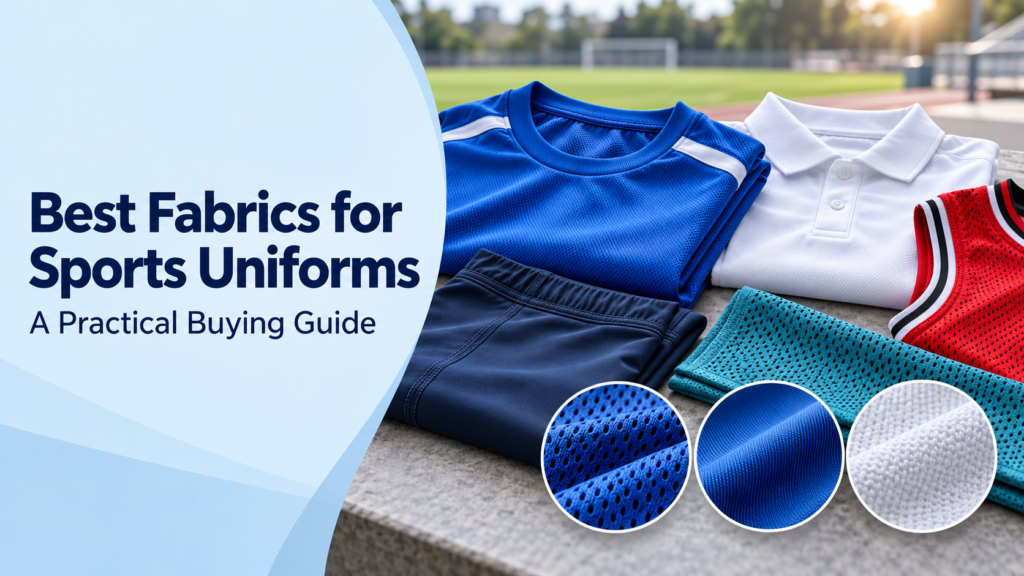
Polyester performance fabrics are a practical starting point for many team jerseys. Cotton blends can suit school sportswear and lighter activities, while elastane blends provide stretch for fitted garments. However, the best choice depends on the sport, fabric construction, fit and washing requirements.
A sports uniform should do more than match your team colours. Players need clothing that feels comfortable and allows them to move freely.
For schools, academies and clubs, choosing fabric also affects maintenance and replacement costs. This guide explains how to compare the main options before placing an order.
What Makes a Good Sports Uniform Fabric?
Before choosing a material, consider how your team will use the uniform. A school sports polo has different requirements from a football match jersey.
Focus on these five features:
- Breathability: How easily air passes through the fabric.
- Moisture management: How the fabric handles and spreads sweat.
- Freedom of movement: Whether players can run, bend and stretch comfortably.
- Durability: How the garment handles regular use and washing.
- Care requirements: Whether the uniform is practical to maintain.
The fibre name alone cannot tell you everything. Fabric weight, knit structure, finishes and garment fit also affect comfort.
Common Fabrics Used for Sports Uniforms
1. Polyester: A Practical Option for Team Jerseys
Polyester is widely used in sports jerseys and training wear. Different constructions can produce lightweight, smooth or textured fabrics.
However, a polyester label does not automatically mean excellent moisture management. Ask about the specific fabric and assess a finished sample.
Consider it for:
- Football jerseys
- Basketball uniforms
- Volleyball kits
- Academy training shirts
What to check: Feel the fabric against your skin. Review ventilation, opacity, stitching and comfort during movement.
2. Cotton: An Option for Casual Sportswear
Cotton offers a familiar feel for everyday clothing. It can be considered for casual team T-shirts, lighter activities and some school sportswear.
For intensive exercise, assess how the selected fabric handles sweat. Ordinary cotton and specially engineered performance cotton should not be treated as identical.
CottonWorks documents cotton treatments designed to improve moisture management. This shows why construction and finishing matter alongside fibre content. CottonWorks™
Consider it for:
- Casual team T-shirts
- Low-intensity activities
- Staff and volunteer clothing
- School event wear
What to check: Review shrinkage guidance, drying behaviour and comfort after activity.
3. Polyester-Cotton Blends: An Option for Everyday Teamwear
Polyester-cotton blends combine both fibres in different proportions. They are worth comparing for school sports polos and general teamwear.
Do not assume that every blend feels or performs the same. Two fabrics with similar fibre percentages may have different weights and constructions.
Consider them for:
- School sports polo shirts
- Corporate sports events
- Coaching staff uniforms
- General academy clothing
What to check: Ask for the exact blend ratio. Review a sample after washing before approving a large order.
4. Elastane Blends: For Garments That Need Stretch
Elastane, also called spandex, is an elastic fibre blended with other materials. LYCRA® is a brand of elastane rather than a separate generic fabric type.
Adding elastane can improve stretch, fit and shape retention. However, the finished garment’s performance still depends on its overall construction. The LYCRA Company
Consider them for:
- Fitted training tops
- Stretch sports shorts
- Leggings
- Garments requiring close-fitting movement
What to check: Test bending, reaching and squatting. The garment should move comfortably without becoming overly tight or transparent.
5. Mesh: A Construction for Ventilation
Mesh describes an open fabric structure, rather than a particular fibre. It may be used across a garment or in selected panels.
When comparing mesh options, consider both airflow and coverage. A more open construction may need careful placement.
Consider it for:
- Basketball jerseys
- Training bibs
- Jersey ventilation panels
- Selected warm-weather teamwear
What to check: Inspect opacity, snagging risk, seam quality and comfort against the skin.
Sports Uniform Fabric Comparison
Use this table as a starting point when requesting samples.
| Fabric option | Potential uses | Main checks before ordering |
|---|---|---|
| Polyester performance fabric | Match jerseys and training shirts | Moisture handling, ventilation and feel |
| Cotton | Casual sportswear and lighter activities | Sweat comfort, shrinkage and drying |
| Polyester-cotton blend | School polos and general teamwear | Blend ratio, washing results and fit |
| Elastane blend | Fitted or stretch garments | Stretch recovery, opacity and comfort |
| Mesh construction | Bibs, jerseys and ventilation panels | Coverage, snagging and seam strength |
How to Choose Fabric for Your Sport
Cricket Uniforms
Compare shirt and trouser fabrics separately. Players need comfortable movement for batting, bowling and fielding.
Check trouser opacity, shirt ventilation and fit when wearing any protective equipment.
Football, Basketball and Volleyball Kits
Assess the uniform during running, reaching and quick changes of direction. Check whether the shirt pulls at the shoulders or the shorts restrict movement.
Review the finished design too. Large printed areas, trims and seams can change how a garment feels.
School Sports Uniforms
School uniforms need to work for different ages, sizes and activity levels. Easy care and comfortable sizing are important purchasing considerations.
Ask students to try representative samples before confirming the size breakdown.
Corporate and Academy Teamwear
Start with the activity and frequency of use. A one-day company event may have different requirements from daily academy training.
Choose garment styles and fabric specifications around those needs.
What Does GSM Mean in Sports Uniform Fabric?
GSM means grams per square metre. It measures fabric weight, not overall quality.
A higher GSM does not automatically make a fabric better. Similarly, a lighter material is not always more breathable or comfortable.
Compare weight alongside construction, opacity, stretch and intended use. Avoid choosing a sports uniform only because its GSM sounds impressive.
Check Printing and Branding Before Finalizing Fabric
Your team logo, player numbers and sponsor graphics should be considered during fabric selection.
Ask the manufacturer:
- Which branding methods suit this fabric?
- Can the design affect stretch or comfort?
- How should the printed garment be washed?
- Can we review the branding on a finished sample?
Assess the complete uniform rather than approving fabric and printing separately.
A Simple Checklist Before Placing a Bulk Order
Before confirming production, review these details:
- Confirm fibre content: Request the exact composition.
- Check movement: Try sport-specific actions in the sample.
- Review sizing: Check fit across representative player sizes.
- Inspect coverage: View the fabric under normal daylight.
- Test washing: Follow the proposed care instructions.
- Approve branding: Check colours, placement, names and numbers.
- Record specifications: Keep the approved fabric and design details for repeat orders.
For Ahmedabad teams, try samples in conditions similar to your planned training or matches. A quick indoor fitting may not reveal how comfortable a uniform feels during activity.
Discuss Sports Uniform Fabrics with Amit Corporate Uniform
Choosing fabric becomes easier when you have clear team requirements. Share your sport, player age groups, garment types, quantities and preferred design.
If you are looking for a sports uniform manufacturer in Ahmedabad, discuss available fabric options with Amit Corporate Uniform before confirming your order.
A sports uniform should do more than match your team colours. Players need clothing that feels comfortable and allows them to move freely.
For schools, academies and clubs, choosing fabric also affects maintenance and replacement costs. This guide explains how to compare the main options before placing an order.
What Makes a Good Sports Uniform Fabric?
Before choosing a material, consider how your team will use the uniform. A school sports polo has different requirements from a football match jersey.
Focus on these five features:
- Breathability: How easily air passes through the fabric.
- Moisture management: How the fabric handles and spreads sweat.
- Freedom of movement: Whether players can run, bend and stretch comfortably.
- Durability: How the garment handles regular use and washing.
- Care requirements: Whether the uniform is practical to maintain.
The fibre name alone cannot tell you everything. Fabric weight, knit structure, finishes and garment fit also affect comfort.
Common Fabrics Used for Sports Uniforms
1. Polyester: A Practical Option for Team Jerseys
Polyester is widely used in sports jerseys and training wear. Different constructions can produce lightweight, smooth or textured fabrics.
However, a polyester label does not automatically mean excellent moisture management. Ask about the specific fabric and assess a finished sample.
Consider it for:
- Football jerseys
- Basketball uniforms
- Volleyball kits
- Academy training shirts
What to check: Feel the fabric against your skin. Review ventilation, opacity, stitching and comfort during movement.
2. Cotton: An Option for Casual Sportswear
Cotton offers a familiar feel for everyday clothing. It can be considered for casual team T-shirts, lighter activities and some school sportswear.
For intensive exercise, assess how the selected fabric handles sweat. Ordinary cotton and specially engineered performance cotton should not be treated as identical.
CottonWorks documents cotton treatments designed to improve moisture management. This shows why construction and finishing matter alongside fibre content. CottonWorks™
Consider it for:
- Casual team T-shirts
- Low-intensity activities
- Staff and volunteer clothing
- School event wear
What to check: Review shrinkage guidance, drying behaviour and comfort after activity.
3. Polyester-Cotton Blends: An Option for Everyday Teamwear
Polyester-cotton blends combine both fibres in different proportions. They are worth comparing for school sports polos and general teamwear.
Do not assume that every blend feels or performs the same. Two fabrics with similar fibre percentages may have different weights and constructions.
Consider them for:
- School sports polo shirts
- Corporate sports events
- Coaching staff uniforms
- General academy clothing
What to check: Ask for the exact blend ratio. Review a sample after washing before approving a large order.
4. Elastane Blends: For Garments That Need Stretch
Elastane, also called spandex, is an elastic fibre blended with other materials. LYCRA® is a brand of elastane rather than a separate generic fabric type.
Adding elastane can improve stretch, fit and shape retention. However, the finished garment’s performance still depends on its overall construction. The LYCRA Company
Consider them for:
- Fitted training tops
- Stretch sports shorts
- Leggings
- Garments requiring close-fitting movement
What to check: Test bending, reaching and squatting. The garment should move comfortably without becoming overly tight or transparent.
5. Mesh: A Construction for Ventilation
Mesh describes an open fabric structure, rather than a particular fibre. It may be used across a garment or in selected panels.
When comparing mesh options, consider both airflow and coverage. A more open construction may need careful placement.
Consider it for:
- Basketball jerseys
- Training bibs
- Jersey ventilation panels
- Selected warm-weather teamwear
What to check: Inspect opacity, snagging risk, seam quality and comfort against the skin.
Sports Uniform Fabric Comparison
Use this table as a starting point when requesting samples.
| Fabric option | Potential uses | Main checks before ordering |
|---|---|---|
| Polyester performance fabric | Match jerseys and training shirts | Moisture handling, ventilation and feel |
| Cotton | Casual sportswear and lighter activities | Sweat comfort, shrinkage and drying |
| Polyester-cotton blend | School polos and general teamwear | Blend ratio, washing results and fit |
| Elastane blend | Fitted or stretch garments | Stretch recovery, opacity and comfort |
| Mesh construction | Bibs, jerseys and ventilation panels | Coverage, snagging and seam strength |
How to Choose Fabric for Your Sport
Cricket Uniforms
Compare shirt and trouser fabrics separately. Players need comfortable movement for batting, bowling and fielding.
Check trouser opacity, shirt ventilation and fit when wearing any protective equipment.
Football, Basketball and Volleyball Kits
Assess the uniform during running, reaching and quick changes of direction. Check whether the shirt pulls at the shoulders or the shorts restrict movement.
Review the finished design too. Large printed areas, trims and seams can change how a garment feels.
School Sports Uniforms
School uniforms need to work for different ages, sizes and activity levels. Easy care and comfortable sizing are important purchasing considerations.
Ask students to try representative samples before confirming the size breakdown.
Corporate and Academy Teamwear
Start with the activity and frequency of use. A one-day company event may have different requirements from daily academy training.
Choose garment styles and fabric specifications around those needs.
What Does GSM Mean in Sports Uniform Fabric?
GSM means grams per square metre. It measures fabric weight, not overall quality.
A higher GSM does not automatically make a fabric better. Similarly, a lighter material is not always more breathable or comfortable.
Compare weight alongside construction, opacity, stretch and intended use. Avoid choosing a sports uniform only because its GSM sounds impressive.
Check Printing and Branding Before Finalizing Fabric
Your team logo, player numbers and sponsor graphics should be considered during fabric selection.
Ask the manufacturer:
- Which branding methods suit this fabric?
- Can the design affect stretch or comfort?
- How should the printed garment be washed?
- Can we review the branding on a finished sample?
Assess the complete uniform rather than approving fabric and printing separately.
A Simple Checklist Before Placing a Bulk Order
Before confirming production, review these details:
- Confirm fibre content: Request the exact composition.
- Check movement: Try sport-specific actions in the sample.
- Review sizing: Check fit across representative player sizes.
- Inspect coverage: View the fabric under normal daylight.
- Test washing: Follow the proposed care instructions.
- Approve branding: Check colours, placement, names and numbers.
- Record specifications: Keep the approved fabric and design details for repeat orders.
For Ahmedabad teams, try samples in conditions similar to your planned training or matches. A quick indoor fitting may not reveal how comfortable a uniform feels during activity.
Discuss Sports Uniform Fabrics with Amit Corporate Uniform
Choosing fabric becomes easier when you have clear team requirements. Share your sport, player age groups, garment types, quantities and preferred design.
If you are looking for a sports uniform manufacturer in Ahmedabad, discuss available fabric options with Amit Corporate Uniform before confirming your order.